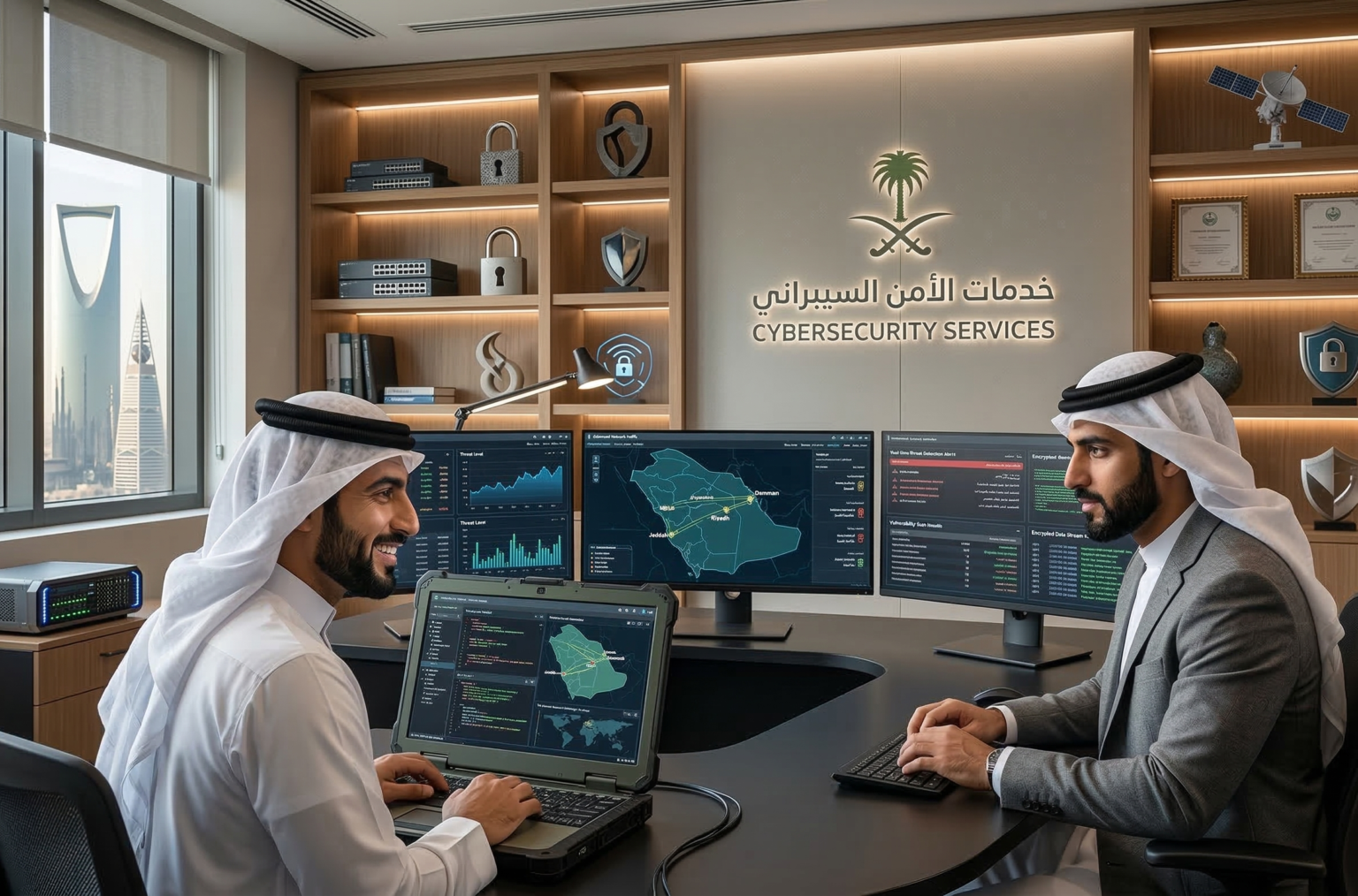
Saudi organizations face increasing threats across endpoints, email, cloud, and identity—while compliance expectations keep rising. Ajnihat Alnajah delivers security services that focus on real control, clear response, and measurable risk reduction, not just reports.
We help you strengthen security while keeping business operations smooth, with practical guidance for enterprise environments and regulated sectors.
You benefit from:
Better visibility across users, systems, and cloud
Faster containment and fewer repeated incidents
Stronger readiness for audits and reviews
Clear ownership, actions, and reporting
Ready to strengthen your enterprise security? Ajnihat Alnajah’s experts are ready to help.
Ajnihat Alnajah delivers enterprise cybersecurity for Saudi organizations to protect infrastructure, applications, identities, and sensitive data. We begin with a focused security review to identify high-risk gaps, then implement practical controls that reduce exposure and improve response speed. Our service strengthens access governance, endpoint and network hardening, cloud security, and incident readiness with clear escalation and reporting.
You gain better visibility, faster containment, and measurable improvements that support PDPL and NCA expectations. Security becomes operational for daily teams—without disrupting business continuity or slowing delivery across offices, branches, and critical services.

Cybersecurity refers to the technologies, policies, and processes used to protect digital systems, networks, and data from unauthorized access or cyber attacks. As organizations adopt cloud computing, digital platforms, and remote collaboration tools, the attack surface for cyber threats expands significantly.
Businesses must secure endpoints, applications, databases, and communication networks to prevent data breaches and operational disruptions. Effective cybersecurity combines technology solutions with security policies, employee awareness.
Cyber attacks can lead to financial losses, reputational damage, and operational disruptions for organizations. Cybersecurity helps businesses protect sensitive information such as financial records, customer data, and intellectual property.
It also ensures that systems remain operational without disruptions caused by malicious activities. By implementing strong security measures, companies reduce vulnerabilities and strengthen trust with customers and partners. In highly regulated sectors such as finance, healthcare, and government, cybersecurity also ensures compliance with data protection regulations and security standards.
Organizations across different industries trust Ajnihat Alnajah for dependable technology services and professional expertise. Our focus on quality, collaboration, and innovation helps businesses achieve stronger digital capabilities and long-term success.
Working with Ajnihat Alnajah has significantly improved our IT operations. Their team understands business needs and delivers practical technology solutions.
The staff augmentation service helped us quickly expand our technical team. The professionals integrated smoothly and contributed immediately to our project delivery.
Their technology solutions helped modernize our infrastructure and improve efficiency across our systems. The team is responsive, knowledgeable, and easy to work with.
Ajnihat Alnajah provided excellent guidance during our digital transformation initiative. Their approach was strategic and focused on long-term business value.
Cybersecurity refers to protecting computer systems, networks, and data from cyber attacks or unauthorized access.
It protects sensitive data, prevents financial losses, and ensures uninterrupted business operations.
Common threats include phishing attacks, malware, ransomware, data breaches, and insider threats.
They can implement security policies, conduct regular audits, train employees, and deploy advanced security technologies.
Yes. Cyber criminals often target smaller organizations because they may have weaker security systems.
Cybersecurity systems should be updated continuously through regular software patches, security monitoring, and periodic risk assessments. Most organizations conduct security audits at least once or twice a year, while critical systems should be monitored in real time to detect and respond to threats immediately.